



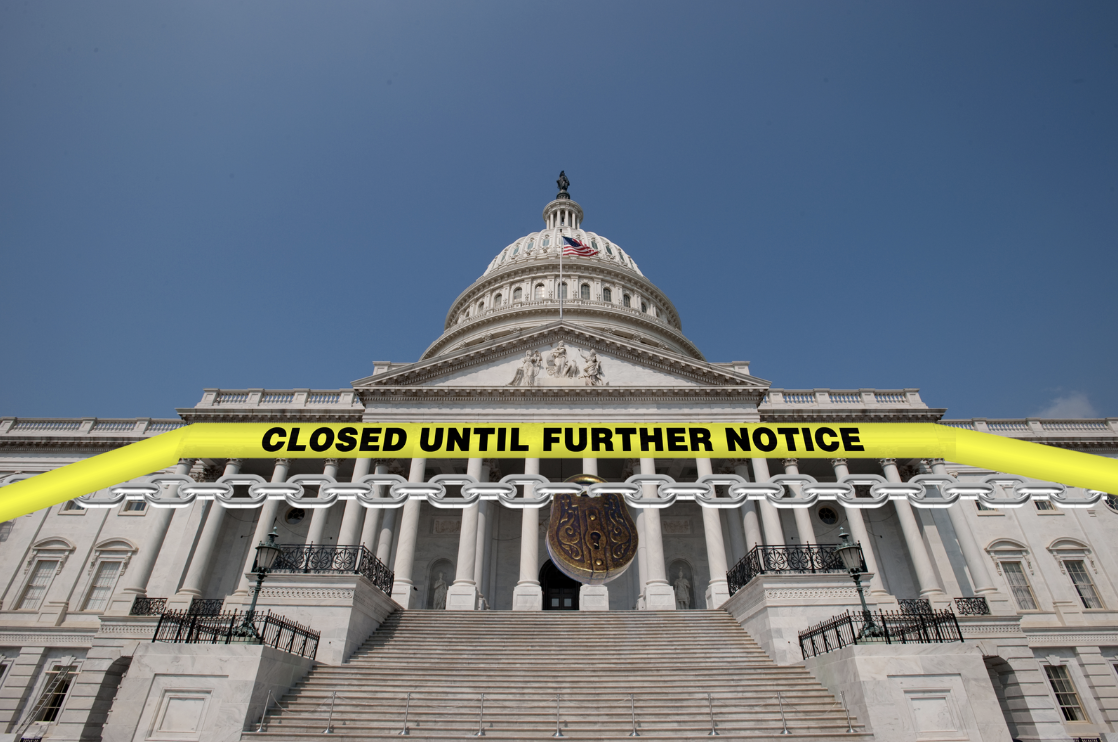









































The 2025 government shutdown has started. Once again, the politicians in Washington have proved that they are reliably unable to compromise. Instead of passing bills, our elected officials are having a staring contest.
Now, you might be asking, “What is a government shutdown?” A government shutdown occurs when Congress can’t pass appropriate bills to continue funding for the next fiscal year. Congress has, however, enacted a continuing resolution that allows continued funding (Balint). A continuing resolution is where Congress temporarily provides funding, which means that once the funding runs out, even more programs will start to shut down. When you look beyond the drama that is Congress, there is discourse among citizens who are affected by the lack of funding. Until all necessary bills are passed, the government is only allowed to operate what is “essential.” Therefore, things that are not considered to be essential, such as national parks, small businesses, and public servants, are unable to receive the help they need. This is what turns a budget debate into a real-world crisis, with the failure to pass a (very important) piece of paper leading to the halt of government operations.
What caused the Shutdown?
Ah yes! It’s that time of the year again. And no, I don’t mean the holidays. The halls of Congress have turned into a high-stakes game of chicken between Democrats and Republicans, and neither side is relenting. As stated, the government has shut down because the appropriate bills have not been passed to continue funding in the next fiscal year. In this case, the issue lies in the Senate.
Despite the Republicans having 53 of the 100 seats in the Senate, they are short of the 60-vote mark that would pass the proposed spending bill. This allows the Democrats to negotiate so that the Republicans can obtain the additional 7 votes needed. To take advantage of this, the Democrats are hoping to include an extension of tax credits and a reversal of Trump’s cuts to Medicaid(Zurcher). The Democrats are doing this, in part, to gain back supporters in the working class; without the tax credits and reversal, the costs of insurance and healthcare would increase next year, hurting the targeted working class significantly. While the Democrats aim to remind voters of the cuts the Republicans have made to healthcare, the Republicans are highlighting that the Democrats’ refusal to compromise is what is causing the shutdown(Seitz).
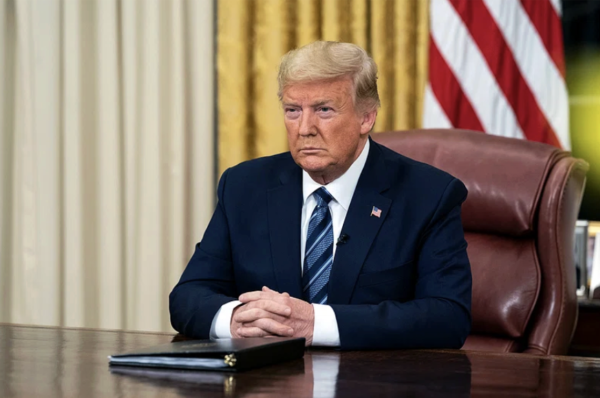
Trump
In the history of the United States, the government has only ever shut down a total of eleven times. Somehow, Trump has had three in total. During Trump’s first presidency, two shutdowns occurred involving the debate over immigration. This year, it’s about healthcare.
Trump has also made a highly skeptical statement regarding the pay back of government employees. During the government shutdown, non-essential employees will be furloughed. Some will continue to work without pay, and at the end of the shutdown, these government workers and public servants will be paid what they were supposed to make during the shutdown. However, in an attempt to threaten the Democrats into signing the bill, Trump threatened to withhold the payment from certain workers.
On September 30th, Trump stated that they would be laying off a significant number of people, including workers at the Cybersecurity and Infrastructure Security Agency. Furthermore, on October 7th, Trump said that the payback “depends on who we’re talking about” and that some workers “don’t deserve to be taken care of” (Balint). However, this is not true; the law states very clearly that furloughed workers are entitled to pay back. The president should not be able to declare that workers will not be paid back since it has been written into law that it’s in their rights to request the pay.
Amidst the shutdown, the Trump administration has also announced the firing of 4,000 federal workers and the cancellation of nearly $8 billion for energy projects. Additionally, the head of the White House Office of Management and Budget, Russell Vought, says that the 4,000 employees fired are “just a snapshot” and that they will continue firing up to “north of 10,000”(Epstein). These cuts are targeted toward programs that Democrats prioritize, such as Health and Human Services and Homeland Security. Some Republicans have stated that they were unaware of the Trump administration’s decision regarding these cuts. Despite this, they still support the decision (Grayer and Adam).
Impacts
During the government shutdown, only operations deemed “essential” continue to operate while “nonessentials” no longer have the funding, including staffing for “essential” programs. In a government shutdown, two groups suffer similar but different fates: the furloughed, who are forced out of work, and the “essential” workers who work without pay. Being furloughed means that you are suspended from work until funding is reestablished. The dual crisis of firings and furloughs leads to a financial crisis for federal workers. As the shutdown prolongs, the lack of immediate paychecks leads to further strain on living standards that workers could’ve afforded before the shutdown.
Although there is a shutdown, this doesn’t mean that the government system stops working altogether. Usually, programs that are related to the public are considered essential. Programs considered essential continue to operate, while those deemed nonessential stop completely. Listed below are programs deemed essential and nonessential (Balint) (Arora):
Essential (operating)
- Border Protection
- Law Enforcement
- Immigration and Customs Enforcement
- Medical Care
- Social Security
- Medicare
- U.S. Postal Services
- Military
- Air traffic (many flights have been cancelled)
- Internal Revenue Service
- Emergency Food and Drug Safety
Nonessential (shut down)
- National Parks
- Museums and Zoos
- Passport/Visa Processing
- Research (Food and Drug, Health, Environmental)
- Loans
In addition to nonessential programs, workers in essential programs are also cut because the government operates life and property. This causes a decrease in the effectiveness of the programs that are still operating, leading to delays and a drop in worker motivation due to fewer employees and no pay.
Government programs and businesses may bear the brunt, but small businesses are also especially affected by the shutdown. Small businesses that rely on tourist attractions, from parks, museums, and zoos, suffer from two problems: they will lose customers, but they can’t apply for or cancel loans when they need the money (Arora).
You might wonder how this situation will impact us. In all honesty, we are very lucky compared to most. Since BISV is a private school, we don’t rely on government funding. However, this can affect field trips due to shutdowns of national parks. One problem for us is that the 9th graders currently on the New York D.C. trips might have to make a few laps around the Washington Monument to pass the time, as it’s one of the only sites still open due to it being located in a park. However, those who have family that work for the government can still be affected so the sooner this problem is solved, the better.
Sources:
Government Shutdown FAQs | U.S. Representative Becca Balint. balint.house.gov/governmentshutdown/#:~:text=If%20a%20new%20appropriations%20bill,due%20to%20lack%20of%20funding.
Zurcher, A. Why Has the US Government Shut Down and What Does It Mean? 15 Oct. 2025, www.bbc.com/news/articles/crrj1znp0pyo.
Seitz, A. “Why Democrats Are Casting the Government Shutdown as a Health Care Showdown.” NPR, 7 Oct. 2025, www.npr.org/2025/10/07/g-s1-92251/government-shutdown-health-insurance-premiums.
Epstein, K. Trump Administration Issues Layoff Notices to More Than 4,000 Workers During Government Shutdown. 11 Oct. 2025, www.bbc.com/news/articles/c1mxd1g71vxo.
Grayer, Annie, and Adam Cancryn. “‘The Communication Culture Sucks:’ Republicans on Capitol Hill in the Dark on Trump Administration Decisions During Shutdown.” CNN, 16 Oct. 2025, www.cnn.com/2025/10/16/politics/republicans-white-house-shutdown.
Arora, Rohit. “3 reasons why the government shutdown is hurting small businesses.” Forbes, 14 Oct. 2025, www.forbes.com/sites/rohitarora/2025/10/14/three-reasons-why-the-government-shutdown-is-hurting-small-businesses.