

























In my previous article, “Maduro’s Crisis,” I covered what happened in Venezuela during early September and the international actions that developed into the crisis. From that period to now, issues have only intensified drastically.
From September 2nd to December 7th, President Donald Trump has conducted at least 21 attacks on vessels in the Caribbean that have been named narcotic ships by the Trump administration, killing at least 83 individuals in the process. Latin American countries like Mexico and Colombia, along with human rights groups, have criticized Trump’s actions as “extrajudicial executions,” which are deliberate killings done by a government without due process that violate international laws and human rights. Ignoring their disapprovals, the Trump administration persisted, accusing Cartel de los Soles of working with the Venezuelan gang Tren de Aragua–previously designated a foreign terrorist organization–to send illegal narcotics to the U.S. Washington officials have also accused Maduro of leading the Cartel de los Soles, which he has denied. Trump responded by claiming that the illegal and terrorist partnerships would grant America the right to strike at Maduro’s assets and infrastructure in Venezuela. Even if the U.S. does not attack Venezuela physically, its debated actions of striking narcotic vessels may cause more turmoil on the international stage and escalate tensions between Latin America and the U.S.
On November 19, President Trump approved additional measures to pressure Venezuela and prepare for a military campaign. Trump signed off on Central Intelligence Agency (CIA) plans for covert measures inside Venezuela, which many believe could lead to war. However, Trump has also authorized negotiations with Maduro. According to the Washington officials, Maduro is an illegitimate president who rigged his “democratic” election; therefore, Maduro had offered to step down in a few years in return for the naval withdrawal, a proposal that America has denied. The U.S. has also rejected a compromise that would allow America access to Venezuela’s oil wealth. Although the presence of warships in the Caribbean concerns Venezuela, there have been no combat forces physically in Venezuela. The New York Times speculates that future attacks could be cyber, psychological, or information operations.
In December, military employees conducted “Operation Southern Spear”, where the U.S. would station large military buildups using the navy’s largest aircraft carrier, at least eight other warships, and F-35 aircraft. These forces involved in this new campaign are larger than the presence following the Cuban Missile Crisis.
All while this was happening in the United States, Iran backed Maduro against the Trump administration during the week of November 16. Iranian Foreign Ministry spokesperson Esmaeil Baqaei warned the United States that its military activity posed a threat to international peace. Trump responded with indifference, simply commenting on Venezuela’s “dump[ing of] hundreds of thousands of people into our country from prisons.”
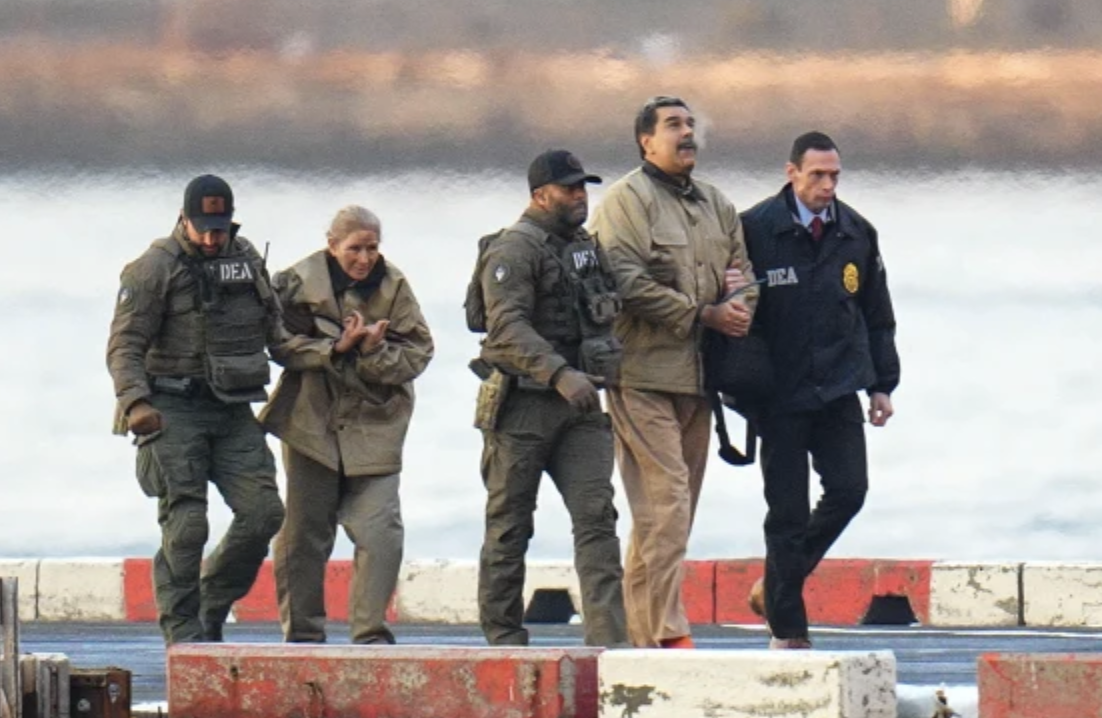
The situation only escalated at the dawn of the new year. On the night of January 3, Maduro was captured by and flown over to the United States who also killed 32 of his military and intelligence members, prompting lots of discourse.
Trump defended his capture of Maduro on the illegitimacy of his presidential rule and involvement in drug trafficking, but he has been criticized by the public for ignoring international law by giving himself the authoritarian power to exert self-policing in other countries. However, he claims that because he was capturing a drug trafficker and not the head of a national sovereignty, he has not broken any laws. However, critics have also pointed out how Trump recently pardoned the previous Honduran President, who was charged with 45 years in prison for trafficking 400 tons of cocaine in December 2025. At the time, Trump reasoned that the treatment of the Honduran President was “unfair,” which was ironic considering how he used drugs as the reason for Maduro’s capture. Internationally, the United Nations (U.N.) has claimed he has broken their laws. The Hungarian Prime Minister Viktor Orbán, a close Trump ally, replied, claiming, “International rules do not govern the decisions of many great powers. This is completely obvious.” Although realistically, the rule of law claims that no one is above the law, his statement finds harsh realities, as countries with power have rarely faced repercussions for their actions.
All of this turmoil gets one wondering: If drugs were not the reason for Maduro’s capture, what was? Speculation seems to point to how Trump is after the oil-rich Venezuelan land, as mentioned in prior editions. He and his advisers are planning an initiative to dominate the Venezuelan oil industry, as the existing structures (state-run) help support the transition. Trump has told his aides that he aims to reduce the price of oil from $60 per barrel to $50 and distribute it in American dollars to the rest of the world. With Venezuelan land containing up to 303 billion barrels of oil, America is predicted to generate up to $15 trillion from oil. Furthermore, the sales of Venezuelan oil in American dollars increase the demand for American dollars. This could be part of Trump’s strategy to increase the U.S. dollar’s worth on the foreign exchange market to balance out the loss in the economy from his previous year. To extract the oil, new infrastructure must also be built, which Trump has claimed he will sponsor for Venezuela on a loan. This would only push Venezuela into debt without a way to repay due to the current American ownership of the oil.
The exploitation of Venezuela’s economy has been used as an argument against those who cite the popularity of Trump’s actions within Venezuela. Some who support Trump’s action argue that Venezuelan citizens would be satisfied to finally get rid of their despised dictator. However, this justification ignores the fact that Trump appointed Delcy Rodríguez, the Vice President of the dictatorial Maduro, to be in charge of Venezuela rather than the rightful winner of the election, María Cochado. People have accused Rodriguez of assisting in America’s capture of Maduro, and this corruption leaves people worried for the future of Venezuelan citizens. If the structure of the ruling authority remains constant, the possibility of changes for the Venezuelan people decreases.
The precedents Trump has set for other countries must also be considered when evaluating the broader implications of his actions. If drug trafficking can be used as an excuse to colonize other countries, it raises an unsettling question: which country could be next? Some suspect Argentina or Colombia. More broadly, this approach forces the international community to confront the extent of power that larger nations can exert over smaller states. Does this give China the go-ahead to conquer Taiwan? What about Russia and Ukraine? This pattern of justification for territorial ambition continues to be seen through Trump’s actions, which have extended beyond the scope of the Venezuela conflict. Trump went so far as to state that he did not “need international law” and that his power was limited only by his “own morality,” raising concerns for the future diplomatic interactions between America and other countries. At the beginning of his presidency, Trump stated his desire to acquire Greenland, an idea that has continued into the current times. “It’s so strategic right now. Greenland is covered with Russian and Chinese ships all over the place,” Trump told reporters on Sunday. “We need Greenland from the standpoint of national security, and Denmark is not going to be able to do it.” If Trump faces no political repercussions for his actions in Venezuela, he could feel emboldened to extend similar forms of colonization into other countries.
For now, the future of Venezuelans is uncertain. On one hand, they have the chance for a better life. On the other hand, the treatment of Venezuelan immigrants in America for the past year–combined with Trump’s economic plans, the lack of a political structural change, and America’s historically unreliable record of political intervention and power vacuums–projects a consistently negative outlook for Venezuelan citizens. Their future depends largely on Trump’s actions in an environment lacking meaningful international regulations.
Sources:
Blanca, Julio. “How the US Attack on Venezuela, Abduction of Maduro Unfolded.” Al Jazeera, Al Jazeera, 4 Jan. 2026, www.aljazeera.com/news/2026/1/4/how-the-us-attack-on-venezuela-abduction-of-maduro-unfolded.
Cano, Regina Garcia. “Trump Has Accused Boat Crews of Being Narco-Terrorists. the Truth, AP Found, Is More Nuanced.” AP News, AP News, 12 Nov. 2025, apnews.com/article/trump-venezuela-boat-strikes-drugs-cocaine-trafficking-95b54a3a5efec74f12f82396a79617ea.
Corder, Mike. “Trump Administration’s Capture of Maduro Raises Unease about the International Legal Framework.” AP News, AP News, 6 Jan. 2026, apnews.com/article/trump-maduro-venezuela-law-un-2e400f5753570b70487fd3d3fa50261e.
Goodman, Joshua. “How Delcy Rodríguez Courted Donald Trump and Rose to Power in Venezuela.” AP News, AP News, 7 Jan. 2026, apnews.com/article/delcy-rodriguez-maduro-trump-venezuela-e71f2289bc801446e05550d8f900a8d1.
Jr, Bernd Debusmann. “How Could Donald Trump ‘take’ Greenland?” BBC News, BBC, 7 Jan. 2026, www.bbc.com/news/articles/c0q4w1xnv35o.
Lachter, Efrat. “Iran Backs Maduro to Keep Latin America Foothold as Trump Increases Pressure on Venezuela.” Fox News, FOX News Network, www.foxnews.com/world/iran-backs-maduro-keep-latin-america-foothold-trump-increases-pressure-venezuela. Accessed 15 Jan. 2026.
Presidential Pardon of Former Honduran President Convicted of Drug Trafficking | Congress.Gov | Library of Congress, www.congress.gov/crs-product/IN12621. Accessed 15 Jan. 2026.
Trump Considers Taking Control of Venezuela’s PDVSA, Lower Oil Prices to $50 a Barrel, WSJ Reports | Reuters, www.reuters.com/business/energy/trump-considers-control-over-venezuelas-pdvsa-lower-oil-prices-50-barrel-wsj-2026-01-08/. Accessed 15 Jan. 2026.
Trump Says U.S. Oversight of Venezuela Could Last for Years – The New York Times, www.nytimes.com/2026/01/08/us/politics/trump-interview-venezuela.html. Accessed 15 Jan. 2026.
“US Has Captured Venezuela’s President Maduro and Wife, Says Trump.” The Guardian, Guardian News and Media, 3 Jan. 2026, www.theguardian.com/world/2026/jan/03/explosions-reported-venezuela-caracas.
Venezuela’s Interior Minister Says 100 People Died in U.S. Attack | Reuters, www.reuters.com/world/americas/venezuelas-interior-minister-says-100-people-died-us-attack-2026-01-08/. Accessed 15 Jan. 2026.
“‘I Don’t Need International Law’: Trump Says Power Constrained Only by ‘My Own Morality.’” The Guardian, Guardian News and Media, 8 Jan. 2026, www.theguardian.com/us-news/2026/jan/08/trump-power-international-law.