


































There is a strange symbol surrounded by mystery to the point of nearly being paradoxical. It’s found all over newspapers, literature, and other publications, but when you look over your own writing, more likely than not, you wouldn’t find a single one for a while, if ever. That punctuation would be—what else—the em dash. Why does this curious symbol seem reserved for professional, fancy writing, while the average person forgets about its existence as soon as they sit down in front of a keyboard?
One reason might be its complicated role in grammar. There are already so many ways to add extra information to a sentence, like this phrase does (and this one too), meaning that double-hyphen-resembling line gets much less attention. Indeed, the em dash often does much the same thing—setting off additional details—as a few of the other techniques listed above, but it has many more highly important uses than that, some of which are to be discussed later.
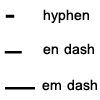
Perhaps there’s a much simpler reason: it’s hard to type an em dash. Look for it on your keyboard and see if you can find it. Maybe “-”? No, too short, that’s a hyphen. What about the longer one above it? Close, but “_” is an underscore. The reality is that adding a single em dash to most digital documents is far more time-consuming than it should be. In Google Docs, for example, you can access it by clicking Insert, selecting “Symbols” from the drop-down menu, clicking “Special symbols” from the smaller menu after that, and searching “em dash” to find it. While there are several possible shortcuts, most are restricted to certain devices or (as the author discovered after testing some of them) don’t work consistently. You might be able to find a faster way to access the em dash, but even then, when alternative phrasing is possible, typing an em dash just isn’t worth the time.
As if things weren’t bad enough for the em dash already, however, it has come under attack after its association with AI-generated text in recent times, which often uses them more often than most human writers would, as Joel Stein of the Wall Street Journal (and many other writers) has reported. The reason for that mostly comes down to one that’s already been mentioned: professional writers both use em dashes and publish their writing more often than the average person, meaning it has a particularly strong influence on the data used to train LLMs. This causes a cycle of anti-em dash sentiment: as writers use fewer em dashes to avoid being accused of AI, the dashes become an even more obvious sign of LLM writing. In other words, one could go so far as to say they become less human.
Avoiding the em dash can make writing harder and more prone to grammatical errors. In addition to adding extra information, em dashes can act like a colon by introducing lists or explanations. There are also uses almost unique to them, such as adding dramatic emphasis. Then again, all of these functions either have alternatives or are optional stylistic choices. For em dashes to be popular again, more people would have to start using them in casual writing, which in turn requires making them easier to type. All this is to say: does it even matter? Should we care if em dashes become obsolete? None of that is really something anyone can just decide, but whatever happens, one thing is certain—em dashes have earned a special place in language.