




















































The Rise of Video Games as Art
Once dismissed as mere entertainment, video games have steadily claimed a place within the world of fine art. Long before galleries and museums took notice, artists built immersive worlds on 16-bit canvases, using flickering pixels on CRT screens as their medium. Today, these digital creations influence architecture, film, music, visual art, and museum curation across the globe. As critics, cultural institutions, and artists themselves began to recognize video games as emotionally, socially, and aesthetically complex works, games moved beyond arcade machines and into museums—tracing a path that reflects an evolving fusion of technology and imagination.
Museums Began Paying Attention
One of the most significant shifts in the minds of the people was the fact that big institutions started to put video games next to any conventional art object. In 2012, the Museum of Modern Art chose 14 video games that it praised for their interaction design and conceptual integrity. This acknowledgement marked that games had a chance of communicating beyond issues of mechanics; as such, they needed cautious authorship, aesthetic philosophy, and imaginative vision as a painting or sculpture. Games were demonstrated as moving artworks based on code, color, movement, and narrative rhythm and were institutionalized as dynamic and influential items rather than being looked down upon as mere distractions.
Interactivity as a New Artistic Language
Video games are also artistic in the sense that they evoke emotional feelings in people. Games are interactive, and therefore, players are allowed to engage in the artistic process as compared to other forms of art. There is an atmosphere created by light, sound, and environmental storytelling to allow the players to enter living paintings. Journey demonstrates that wordless narrative and bare scenery can create feelings, just the way beautiful art can. According to scholars, such games produce what is known as the moments of digital sublime: experiences of wonder, sadness, and sublimity, which are generally attributed to classical paintings or even poetry. Interactive games provide a fresh language in art in which the movements and images form meaning.
The Visual Cultures Inspired by Games
Outside museums and academia, video games have triggered new visual cultures, which have an impact on contemporary art. Nowadays, independent game developers frequently perceive each scene as a canvas and are inspired by watercolor, surrealism, manga, and realism. In the meantime, a large number of digital artists reinterpret game characters and game worlds, combining fan art and fine art. Game-inspired art has found it easier to congregate collectively via traditional salons, which include conventions, online galleries, and social media as well, creating communities of aesthetics. There are pixel-art shows and retro-style illustrations that make it clear that even the initial graphical constraints were used as a signature of this style and demonstrate that artistic creativity is flourishing despite restrictions.
A Medium That Continues to Redefine Art
With the advancement of technology, the medium still drives art through experiments. Real-time effects render theatrical light and complicated textures into games, whereas VR and AR create new, established visual experiences. These inventions show that video games are not only stealing art’s history, but also creating it. The composition and the color theory are taught to a new generation of artists through the landscapes in The Legend of Zelda, Hollow Knight, and Red Dead Redemption 2. Games have influenced careers in animation, design, architecture, and fine arts.
Video games have also demonstrated their ability to express art, from the modest pixels all the way to digital paintings that bring the world of art a lot closer. Fast-growing tools are coupled with technology, narrative-building, the playability of the game, graphic creativity, and cultural fantasy. Video games have become superfluous to the acceptance of art itself because as museums exhibit games, historians study them, and artists get inspired by them. As museums exhibit video games, historians study them, and artists draw inspiration from them, video games have firmly established themselves as a powerful and evolving artistic medium.
Works Cited:
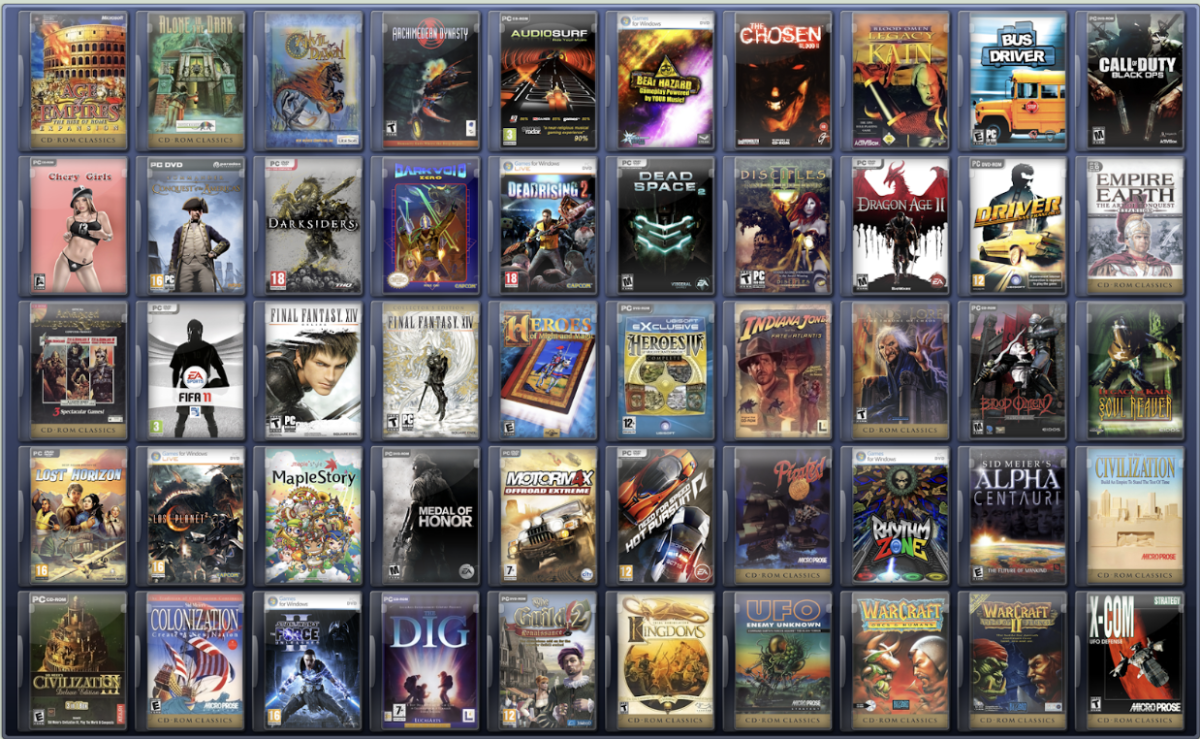
Image: https://www.deviantart.com/gameboxicons/art/Game-Icons-40-173546915
“Video Games: 14 in the Collection, for Starters.” Museum of Modern Art, 2012.
Smith, Noah. “Why Video Games Are the Most Important Art Form of Our Time.” The Atlantic, 2021.
Totilo, Stephen. “When Video Games Enter the Museum.” Kotaku, 2012.
Tanenbaum, Karen et al. “The Aesthetics of Play: A Study of Artistic Expression in Games.” Journal of Game Design and Development Education, 2019.