
















































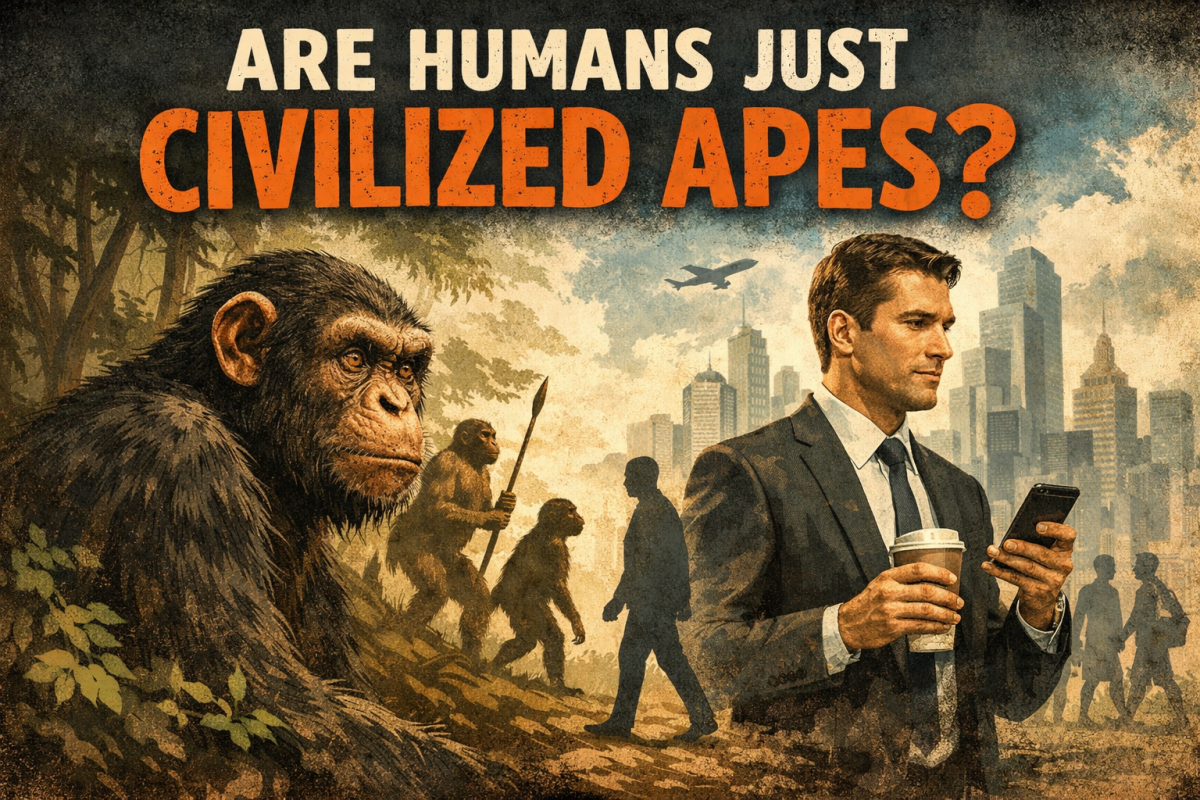
The novel Planet of the Apes (not the movie), written by Pierre Boule, takes place in a distant world, Soror, where the roles of apes and humans are completely reversed. The apes of Soror have acquired the quality of humanity and are like humans in many aspects, while the human race has degenerated into a primitive state. While clearly absurd, this novel raises quite a few interesting points. Through the novel, the author makes strong arguments about human nature and the quality of being human.
In the novel, there is a professor named Antelle who lands on the planet and is imprisoned by the apes. Before being captured by the apes, Professor Antelle was one of the most brilliant scientists on Earth. He designed and built a spacecraft that could reach the speed of light. However, after being captured by apes and put in a cage with degenerated, unintelligent humans, Professor Antelle devolved into an animal. “There in front of me, without moving his lips, while my heart went numb with horror, Professor Antelle gave vent to a long-drawn-out howl” (Pg. 111). This is partially because Professor Antelle is a misanthrope who rejects human society, and perhaps he finds an unintelligent, animal-like existence to be more appealing to him than human civilization. The author also notes that Professor Antelle devolved into this state because, unlike his companion Ulysses, he had no meaningful anchor or pillar in his life to support him and prevent him from regressing into a primitive human. The author is trying to make the point that our sense of “humanity” is closely tied to our proximity to other intelligent beings and our attachment to society. Even the most intelligent human can lose this sense of “humanity” when completely cut off from civilization and placed in a cage without any intellectual equal with whom they can communicate or exchange ideas.
The apes’ rapid acquisition of human traits and behavior in the novel also draws a parallel to some of the apes and chimpanzees in our labs who have learned to mimic us to some extent. In the novel, it is revealed that the apes of Soror were once unintelligent like the apes on Earth, but due to human experimentation on them, their intelligence and memory increased, leading them to eventually succeed and take over the role of humans as the masters of Soror. Through this, the author is making the point that “humanity” is not something that is unique or limited only to the human species. Here, “humanity” is used to mean the set of qualities and traits that are usually associated with humans and are believed to differentiate humans from the lower classes of animals. The author believes that this “humanity” can be imitated by other animals; in his fictional world, the apes copy human behavior, and soon they have the exact same mental traits as human beings. He adds that, in fact, even well-trained animals without intelligence would be able to mimic and recreate human behavior. This leads the author to his assertion that the quality of “humanity” is only a conditioned reflex. For instance, after analyzing the behavior of many humans in society, the author concludes his novel by noting that many human jobs such as drafting reports, making speeches, etc… do not require a rational being to do it; he in fact believes that society could still function if humans were replaced by highly conditioned animals who were trained to make the right motions and gestateright speeches under certain circumstances and deliver “a few harangues all based on the same model”. He sees it as nothing more than “aping” and conditional reflexes which can be imitated by any well-enough trained animal. Perhaps humans really aren’t too different from apes after all.
The author also observes that some prominent traits that plague humanity are arrogance and hubris. He shows this through comparison of the apes in his world and the humans in our world. The apes of Soror all have human minds and are a reflection of the humans on Earth. The author portrays the ape scientists as stubborn, pompous, and self-assured that apes are the only intelligent species and that humans cannot possibly possess “ape-like qualities”. For instance, when they hold Ulysses in captivity and conduct behavioral experiments on him, they refuse to recognize his intelligence despite the fact that he solves all the puzzles in record time. This behavior, in fact, is the reason why the apes’ technology advances so slowly. They are unable to let go of conservative values and beliefs, continuously publishing content that has long been disproven. The behavior of the ape scientists is very similar to how many humans believe that only the human species can possess the quality of “humanity”. On Earth, humans also conduct experiments on apes and chimpanzees (for instance, Nim Chimpsky). However, despite all the outstanding results, human scientists refused to accept the fact that another species may be just as intelligent as they are (or even more intelligent); they even came up with many arguments against it due to their fear of the complete upheaval of behavioral science. This same stubbornness and closed-mindedness apply to nearly all other fields of research. For instance, when Copernicus proposed the (more accurate) theory about the solar system, officials declared him to be a heretic and didn’t accept his ideas because they contradicted the geocentric theory, which was the basis of many of their old doctrines. As this shows, arrogance and superiority towards other species are characteristics of humans that have hindered the progress of civilization for centuries.
Through the novel Planet of the Apes, the author makes many strong points about the basic nature of humanity. This is shown through his analysis of the regression of Professor Antelle, the apes’ rapid acquisition of human technology, and the apes’ denial of Ulysses’ intelligence. Perhaps the reason for this is that the author wrote this in an era in which human behavioral scientists were obsessed with finding out the answer to the ultimate question: whether other species could possibly be intelligent like humans. In this novel, the author leaves us a lot of interesting food for thought about whether humans are truly a superior species or whether they just happened to be particularly adept at “aping”.