































[image generated by ChatGPT]
– Japan’s Biostar Angel Stem Cell Therapy and the United States’ Jaguar JAG201 SHANK3 Gene Therapy for ASD
On August 9, 2025, during the “Light of Tomorrow” summer camp on Cangshan Mountain in Dali, Yunnan, China, an eight-year-old autistic boy named Xiaokai went missing. On August 13, rescuers found him in a mountain stream north of Qingbi Creek in Dali Town, but he showed no signs of life. The autopsy report released on August 27 indicated that Xiaokai had died from starvation, dehydration, and hypothermic shock. In interviews afterward, Xiaokai’s parents said that they had sent him to the hiking camp because they believed in a claim that outdoor exercise could help treat Autism Spectrum Disorder (ASD).
Autism Spectrum Disorder is a neurodevelopmental condition that influences a person’s ability to communicate, interact socially, and behave. People on the spectrum may have difficulty with things such as making eye contact or understanding social cues. It may mean struggling with repetitive behaviors and limited interests. For some, trouble with sensory sensitivities, learning, and adapting are a challenge. While the exact causes of ASD are still being studied, researchers believe a combination of genetic and environmental factors play a role.The brains of people with ASD often show atypical development in regions important for social development, emotions, and executive function, like the amygdala which helps with processing emotions or the pre-frontal cortex, which controls social judgement. Imbalances in neurotransmitters and dysregulated sensory systems can lead to hypersensitivity and repetitive behavior.
Xiaokai’s tragic death is heartbreaking, but a piece of medical news from Japan has reignited hope. On August 11, 2025, Japan’s Ministry of Health, Labour and Welfare (MHLW) approved the “Angel Stem Cell Therapy” developed by the Biostar Stem Cell Technology Research Institute for the treatment of ASD.
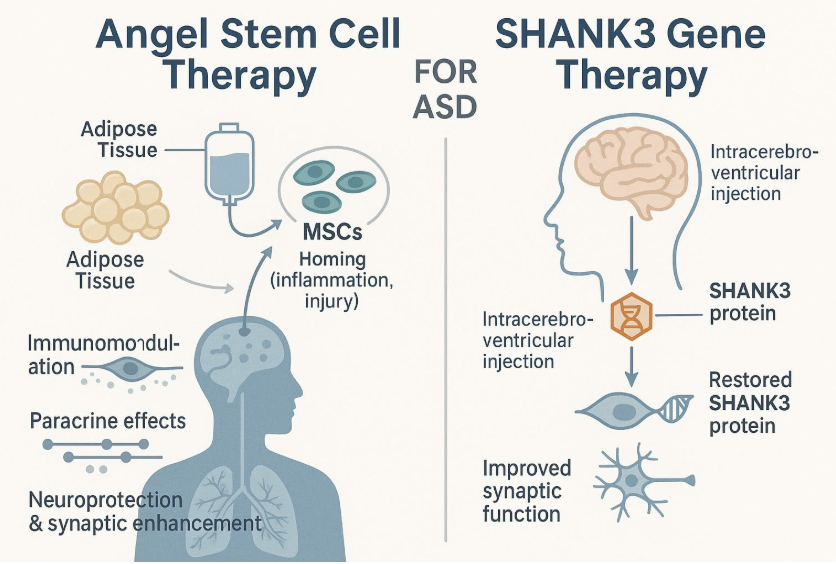
Biostar is a research institute jointly established by U.S. Stemcellbio, Korea’s Nature Cell, and Japan’s Japan Angel Stem Cell Company (JASC). The “Angel Stem Cell Therapy” mainly involves extracting adipose tissue from the patient, isolating autologous mesenchymal stem cells (MSCs), and then delivering these MSCs back into the bloodstream via intravenous injection. Once inside the body, the MSCs can cross blood vessel walls and migrate into the central nervous system, especially in areas of inflammation or micro-damage. These stem cells secrete large amounts of bioactive molecules such as growth factors, neurotrophic factors, immunomodulatory factors, as well as exosomes, thereby promoting neural repair, reducing inflammation, and strengthening neural connections. MSCs help shift the immune system from a pro-inflammatory to an anti-inflammatory state, alleviating chronic neuroinflammation. Secreted factors such as BDNF, NGF, and IGF-1 promote neuronal survival, synapse formation, and synaptic function, thereby potentially improving core autism symptoms.
Coincidentally, on January 31, 2024, the U.S. company Jaguar Gene Therapy announced that the FDA had cleared its Investigational New Drug (IND) application for SHANK3 gene therapy, meaning that its therapy JAG201 could enter clinical trials. JAG201 is a gene therapy that uses an AAV9 vector to deliver a functional SHANK3 gene to treat autism and Phelan-McDermid syndrome caused by SHANK3 gene deficiency. The therapy uses intracerebroventricular (ICV) injection with AAV9. This is a one-time ventricular injection that delivers the viral vector directly into the central nervous system, enabling long-term expression through gene transduction. Jaguar has already partnered with the Mount Sinai Seaver Autism Center in New York, Rush University in Chicago, and Boston Children’s Hospital to recruit children with autism aged 12–36 months for clinical trials. As of August 8, 2025, two pediatric patients had received the therapy, with no treatment-related adverse safety events observed so far.
Unlike Japan’s Angel Stem Cell Therapy, which targets a broad population of ASD patients (age 4 and above) without distinguishing genetic subtypes, Jaguar’s JAG201 (SHANK3 Gene Therapy) in the U.S. is specifically aimed at ASD and Phelan-McDermid syndrome caused by SHANK3 gene defects. It serves a population defined by precise molecular diagnosis, belonging to single-gene deficiency disorders.
Whether it’s Japan’s Angel Stem Cell Therapy or the U.S ‘s Jaguar JAG201, the emergence of these new cures signifies that humanity is steadily making breakthroughs in the vast frontier of addressing autism. We have reason to believe that the future holds promise, and countless children like Xiaokai and their families may one day find relief from the suffering brought by autism.
Sources:
Samatharenigunta. “Biostar’s Angel Stem Cell Therapy Gains Japan Approval for Autism.” Pharmaceutical Technology, 11 Aug. 2025, www.pharmaceutical-technology .com/news/biostars-angel-stem-cell-therapy-japan-autism/.
Neer, Kate. “Jaguar Gene Therapy Announces FDA CLEARANCE OF IND to Study Jag201 in a Genetic Form of Autism Spectrum Disorder and Phelan-MCDERMID Syndrome: Jaguar Gene Therapy.” Jaguar Gene Therapy | Accelerating Breakthroughs in Gene Therapy, 31 Jan. 2024, jaguargenetherapy.com/press-release/jaguar-gene-therapy- announces-fda-clearance-of-ind-to-study-jag201-in-a-genetic-form-of-autism-spectrum-disorder-and-phelan-mcdermid-syndrome/.
Sumaart.com. “MHLW Approves Biostar’s Autologous Stem Cell Therapy for ASD: Packgene Biotech.” Packgene, 12 Aug. 2025, www.packgene.com/frontier/08112-biostar/.