













































Minecraft is one of the most popular video games in the world, with one of its most notable features being its ability to generate a unique world as you explore. Although there is a limit to the size of each world, it’s so high that, at 60 million blocks on each side, it might as well be infinite. This algorithm works by loading undiscovered areas, creating terrain to fill the newly explored space using randomized noise functions. The full process is much more complicated, as the game’s code also considers factors such as the placement of its many biomes and the types of blocks found in each biome. This doesn’t mean that every world is completely random and can’t be replicated: each world’s generation starts with a seed, which determines how the generation process occurs, and every world with the same seed is created the same way. Given that Minecraft’s world generation algorithm more or less places blocks on the fly, does it really capture the type of terrain found in real life?
First, it’s helpful to clarify what a block in the game actually means. The official definition is that each block is a cube with a side length of one meter. Comparing this definition to the size of objects in the game, the proportions make sense at first. The player is 1.8 blocks tall, giving them a height of 1.8m or about 5’11”. One of the first things many players do upon creating a new Minecraft world is find a tree to collect wood, and this seems realistic too: most trees have one-block-thick trunks, and while only larger real-world tree species have trunks with diameters of one meter, they are by no means uncommon.
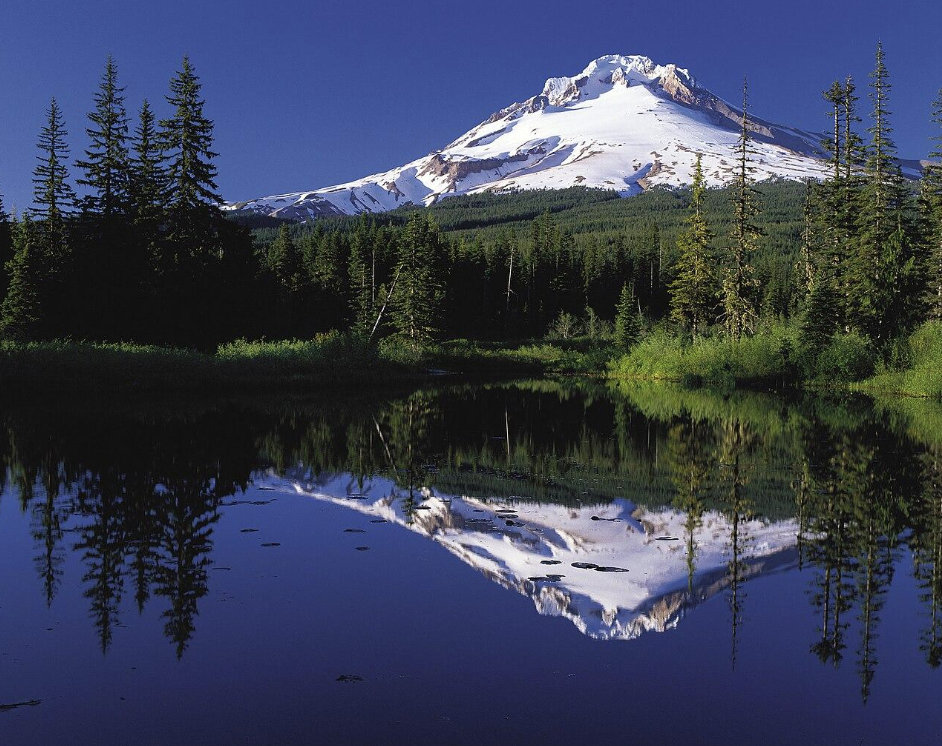
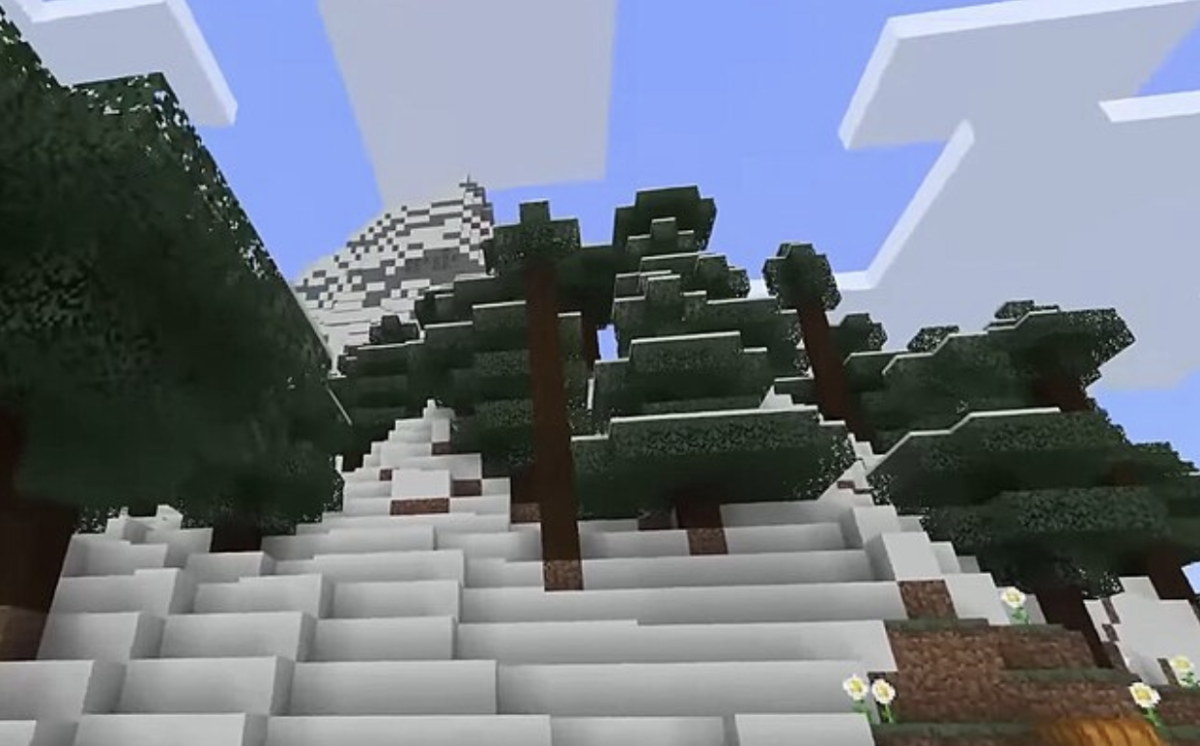
Looking up from the forest, however, we find our first problem: the mountains. In Minecraft, mountains are limited to a y-coordinate of 256, while the sea level is defined around y = 63. This means that even the tallest Minecraft mountains reach an altitude of only 193 meters (633 feet) above sea level, which in the real world only qualifies as a small hill. Surrounding these highest peaks is the cloud layer, which occupies the y-coordinates between 192 and 196, meaning cloud bases are found at 69 meters (226 feet) above sea level. In real life, these would be considered low clouds; mid-level and high clouds, which occur at elevations of up to 22,000 feet, are not found anywhere in a Minecraft world.
Standing at the top of one of these peaks, a player can often see bodies of water scattered around them. This presents another problem. Upon closer inspection, none of Minecraft’s rivers actually have flowing water. Essentially, they’re just narrow, winding lakes. There is no gradient for the water to flow down either. As a result, while bodies of water can appear convincing on relatively flat terrain and near oceans, there is a notable lack of alpine lakes and flowing creeks like those found in Earth’s more mountainous regions.
The increasingly evident differences between Minecraft worlds and real life become even clearer when looking at the Minecraft world as a whole. Minecraft’s world generation only creates small sections at a time, meaning the structure of the world in its entirety isn’t considered as the terrain is created. Vast, towering mountain ranges such as the Rockies, Alps, and Himalayas, which nearly span entire continents, simply won’t be found in the game. In fact, Minecraft worlds don’t truly have continents or oceans at all; while there are ocean biomes in the game that seem to stretch to the horizon, looking at a map of the entire world will reveal that they’re no larger than real-life lakes, and the world in Minecraft consists of one solid piece of land dotted with many “oceans.” Additionally, the concept of the equator and the poles doesn’t exist in-game, and while there are certainly biomes that imitate tropical and polar regions, they’re not limited to any set of coordinates and can be found across the world.
In the end, do these differences really matter? The fact that mountains aren’t tall enough or biomes aren’t arranged realistically has little impact on gameplay, and the lack of an organized world structure is, after all, what allows the game to create such large worlds in the first place. There are many other illogical aspects of the game, for that matter. Gravity only applies to a few blocks, tools can be crafted only from raw materials, and so on. The sometimes unrealistic appearance of Minecraft worlds, then, can be seen as a tradeoff, allowing the game to create countless worlds, each so large they’re practically infinite.