




















































After you’ve cooked up a universe, it will eventually start to envelop you. Now, you will need to learn how to survive from the very start of your universe to every possible end.
- First things first, you will need some form of protective suit to shield yourself from the large amount of cosmic background radiation emitted by stars and galaxies. A spaceship will also be needed, as you should attempt to find a planet in a stable enough area to avoid the chaos of early star systems. There are a few other requirements this planet and star system should fulfil to help you survive in the early universe:
- The planet should ideally be within the habitable zone of its closest star, not too far nor too close. If it is too far, oceans will freeze harder than bedrock. If they are too close, the planet becomes hotter than Tartarus.
- Once you land, you should check for steam or ice. If you see either one (or in the most unlikely case, both) at a spot near the mid latitudes of the planet, it is unsuitable for human life. If there is steam, it is very likely to be too hot and burn anything alive. If there’s ice, this means the oceans have frozen over. Without an ocean reaching the surface, life will have a hard time actually leaving and expanding.
- The planet should be near a stable star, such as a medium yellow star like our sun. If the star is too unstable, the temperature of the planet may become inconsistent and unable to sustain liquid water.
- The planet should ideally have life already, such as spiders dashing around, or other signs of microbial and basic life.
- If the planet already has signs of intelligent life, then you will have to somehow control them. One way is to use this symbol to mind control them:

- Research and toss in a bunch of papers and information about science and mathematics. This will help the creatures in your universe (for example, the cubes mentioned in the previous article) grow and blossom. It is also advised that you simply blend all of it up into a paste, then add copious amounts of Red 40 in order to give them some very powerful abilities. To help with architecture, give them a giant panel with a bunch of options that range from simple blocks and spikes to a variety of triggers that can change a lot of things. These triggers can change the position, color, size, orientation, and more of objects, including themselves.
- Add a sprinkle of Unity to your universe to help stimulate the formation of countries and alliances. The fauna and flora on your planet will likely form countries by this point, but if you need to speed it up further, this can be done.
- If these countries start to make mascots out of a round version of their flag with white circles for eyes, then this is completely normal and desirable. This shows that your universe is ready to move on to the next phase, which is the ultimate phase and fate of your universe.
- Since civilizations have begun forming, you have 2 options for how you want to manage them now: You can either accept the sacrifices they will give you or demand more taxes. However, if you demand too many taxes, it is very likely that your universe will erupt into chaos due to rebellion.
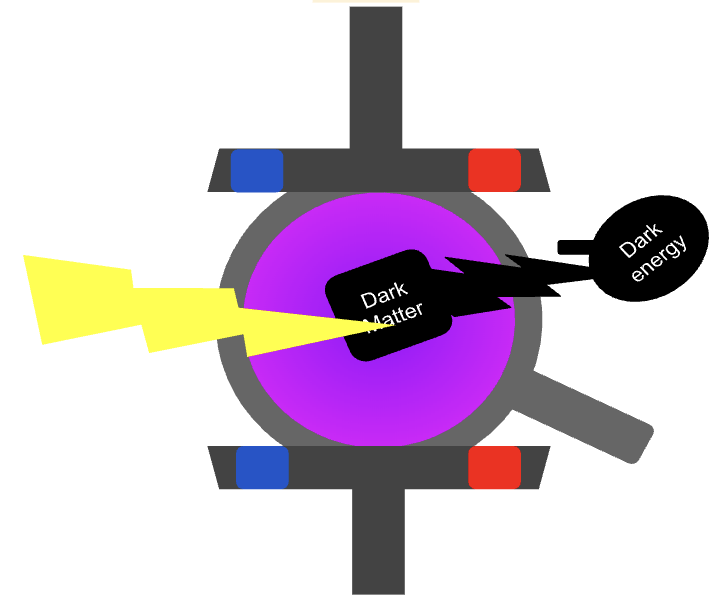
- Once the civilizations on your planet have put aside their differences and have started to explore the reaches of outer space, feel free to remove some of the dark energy from around your universe and/or add in some extra dark matter. Dark energy speeds up the expansion of the universe, and as the universe becomes larger, it becomes harder for civilizations to develop.
- Add more planets and stars; this way, it is easier for your civilization to branch out.
- Adjust the speed of light in your universe in order to allow for faster travel. However, if you adjust it too quickly, this may corrupt the universe and tear apart the fabric of space-time, which could cause a myriad of problems. Alternatively, you can just wait until your civilization discovers faster-than-light travel.
- In case the asteroids start to come alive, you should break their shells, causing them to glow tragically beautiful colors. In order to prevent your civilization’s astronauts from being lost, you can make sure they use tinted glass on their spaceships. In fact, you can even give them a powerful technology that allows them to use them for fuel.
After waiting a few dozen trillion years, the last main-sequence stars, red dwarfs, will die out. Now, you will need to start setting up rotating black holes or use a baseball bat to spin any static ones. Soon, your civilization will end. There are three ways this may happen, with each scenario occurring depending upon the amount of dark energy you put into your universe at the very beginning:
- If you put too little dark energy into your universe, then it will collapse on itself, turning it into a singularity again. However, there is still a chance for it to revive.
- If you put too much dark energy into your universe, it will rip itself to pieces.
- If you put a decent amount but not too much dark energy in, eventually everything will become more and more diluted by space, causing everything to freeze to death.
There are certain methods of surviving in each of these scenarios:
- In the case there’s too little dark energy in your universe, you have to go to your universe settings you picked when you made your universe and turn on the “repeatable big bang” setting. However, there is a 1 in 92 chance that this will fail and your universe ends up dying.
- In the case you put too much dark energy in your universe, you will have to add a new good to your tech tree: High torsion universe stabilizers. Your civilization should use this in order to prevent the universe from breaking apart. Another option is to confine your universe in a ball of flex tape and wait for something to consume the dark energy. You can build a machine that eats dark energy, and it’s very likely your civilization will nickname it “Fitzgerald”:

- The eye is a blue orb and a lot of dark matter will be needed to build this.
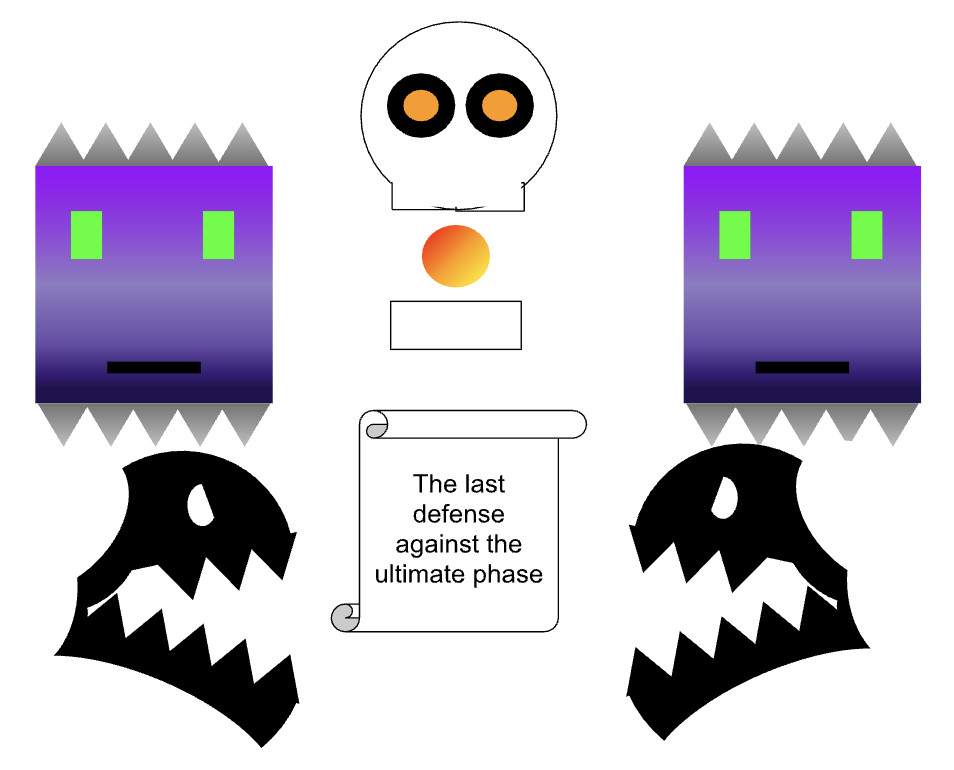
- There are 2 other monsters shown below that can assist Fitzgerald in this situation:


-
- If you put the right amount of dark energy into your universe, then make sure your civilization has unlocked the “Amplified Penrose Process” technology, which allows them to take energy from black holes. The Penrose process is when you throw a mass into a spinning black hole and you obtain some of the rotating energy of the black hole as an exchange. Your civilization should be able to amplify it in order to maximize the energy output to mass ratio. In order to speed this up, give them all caps that look like this:

- If you put the right amount of dark energy into your universe, then make sure your civilization has unlocked the “Amplified Penrose Process” technology, which allows them to take energy from black holes. The Penrose process is when you throw a mass into a spinning black hole and you obtain some of the rotating energy of the black hole as an exchange. Your civilization should be able to amplify it in order to maximize the energy output to mass ratio. In order to speed this up, give them all caps that look like this:
These caps for their minds will help to speed up development of their minds and make them stronger and more intelligent than any natural biology allows. The rate of development of their brains is equal to exactly 825 times what their previous thinking space would allow them to process. This increase happens approximately every 7 minutes and 25 seconds, but this number can vary with the time of day your universe was created, going from under 5 minutes to up to 18 minutes.
- Another technology that can help your civilization obtain energy from the black hole is the “Superradiant Scattering Wave Reactors” technology, which requires 20 billion gold coins, 100 billion general supplies, 5 million intel points, 1 million photon generators(solar age), 1 million electromagnetic material(solar age), 1 million magnetic mirrors(Universe’s twilight age), and 1 million Quark accelerators(Universe’s twilight age). This technology helps your civilization to build a black hole based contraption where you fire an electromagnetic wave into the black hole surrounded by magnetic mirrors, the wave will undergo superradiant scattering, and by opening holes inside of the shell, you can extract this energy. However, your civilization may attempt to weaponize this by using a FTL motor in order to fire the contraption at opposing civilizations and letting it blow up.
- In order to make sure that your civilizations are able to stay in orbit, give them a variety of orbs to use for material. All orbs are color coded to do one specific purpose.

- The pink, yellow, and red orbs will boost your cubes by about 1 feet, 2 feet, and 3 feet each. The black orbs will immediately push down your cubes to the nearest surface. The blue and green orbs will help your cubes flip upside down, which can be useful in fixing certain contraptions, especially for smaller cubes. Each orb is about 2 feet 8 inches wide and high. The green and pink dash orbs(the orbs with a “>” sign inside) will boost your cubes and let them keep moving until they hit an S block(The grey rectangle with an S in it). The green orb will flip a cube upside down, while a pink one will keep it right side up. The spider orb(the orb with 2 upside down triangles) can be oriented to instantly change the gravity of a cube upon touching it.
However, there is one ultimate cheat code to this. Read my next article to find out, and happy building! Be sure that by this point, your civilization is around a rotating black hole and has researched radiation-reflecting materials, as this will be necessary for later.