



































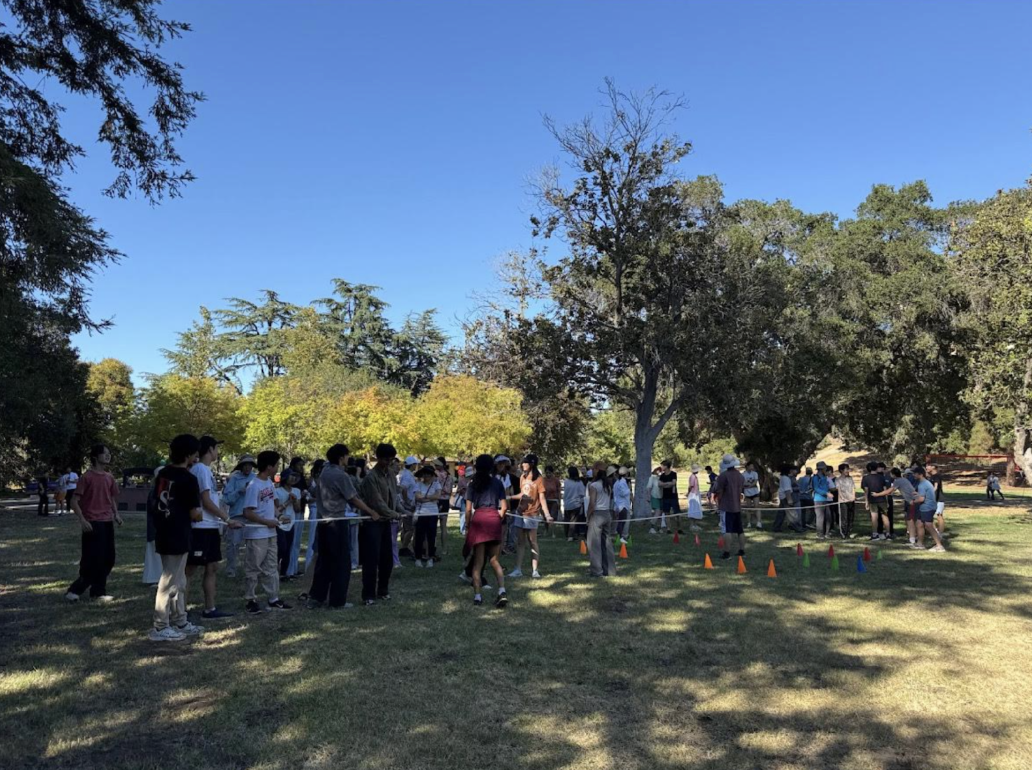
When you hear the words “tug-of-war,” what image appears in your mind? A blank space? A War? Or perhaps a long rope and a group of people straining to pull it with all their might? Interestingly, despite the rope being central to the game, the Chinese name for it is not “pulling the rope” (BaSheng), but “pulling the river” (BaHe). Why might that be?
Tug-of-war is a sport in which two teams pull on opposite ends of a rope, testing their strength and coordination. The earliest record of tug-of-war dates back to around the 5th century BCE, in The Book of Mozi, which is a collection of Mozi’s (a founder of the Mohist school of thought during the Spring and Autumn and Warring States periods) philosophical ideas and his disciples’ writings, which also include early Chinese studies of natural science. Tug-of-war also appears in Jing Chu Suishi Ji (The Seasonal Customs of Jingchu), written by Zong Lin during the Southern Liang dynasty of the 5th century CE. It records the seasonal customs and folk traditions of the ancient Chu region, corresponding roughly to today’s Hubei and Hunan provinces.
“Gongshu Ban traveled to Chu and created naval warfare weapons. When retreating, they hooked the enemy’s ships; when advancing, they resisted them. This was called gouqiang (hook- spear),” (Jing Chu Suishi Ji). This means that Gongshu Ban (better known as Lu Ban, the legendary Chinese master craftsman of the 5th–4th centuries BCE) invented a ship-borne weapon for the state of Chu which consisted of hooks and poles attached to long ropes: when their army gained the upper hand, soldiers used the hooks to latch onto enemy ships and pull them back; when in retreat, they used the poles to push enemy ships away.
So how did this military tool, gouqiang, evolve into the folk game known as “the hook-and-pull contest” and eventually become what we now call “tug-of-war”?
Since gouqiang required immense strength and coordinated teamwork, it gradually became a regular training exercise for ancient naval soldiers. Over time, this training moved from water to land, and from the military to the general public, transforming into a popular group sport. The hooks and poles were replaced with soft ropes. During competitions, drums were beaten to boost morale, and spectators cheered in unison. A large flag was placed in the middle of the rope, with two vertical lines, called “river boundary lines,” drawn on the ground on either side. The outcome of the match was determined by which team pulled the flag past the boundary line. Thus, the “hook-and-pull contest” evolved into what we now call “tug-of-war.”
In the 7th century, under the Tang dynasty, the game was formally named bahe (拔河, literally “pulling the river”) and became a popular festival activity during events such as the Qingming Festival and the Lantern Festival. The rules and equipment were improved: soft hemp ropes or even large bamboo poles replaced the earlier rough cables, reducing injuries to the hands.
Emperor Xuanzong of Tang, named Li Longji, even wrote a poem about it, titled Watching the Folk Tug of War:
“Folk say this contest ensures a bountiful year,
So the northern troops are ordered to play.
Strong men test their might by the long river’s edge,
Practicing valor, learning that victory and loss are both part of life.
Their shouts rise like mountains, their spirit surges like waves.
May the coming year be abundant, as joyful as this day.”
The general meaning of this poem is that this game, passed down through the generations, must bring a year of good harvests. The strong soldiers always summon courage and gather by the river, and to develop a heroic spirit, one must understand that victory and defeat are both common. The soldiers’ shouts rise as high as mountains, and their morale surges like waves. They hope for a year of abundance, just like this joyful moment.
Through this poem, the game gained a new meaning—it became a symbol of hope for a good harvest.
In the 20th century, tug of war was no longer confined to China—it entered the international stage and even became an Olympic event. From 1900 to 1920, tug-of-war was included in the Summer Olympic Games. In the 1900 Paris Olympics, teams were mixed with athletes from different countries. Later, in the 1904 St. Louis and 1908 London Games, club teams competed instead, resulting in host nation dominance. Starting in 1912, only one team per nation could enter. Each team had eight members. Across five Olympic Games, the champions were the joint Denmark–Sweden team, the United States, Great Britain, Sweden, and Great Britain again.
After the 1920 Antwerp Olympics, tug of war was removed from the Games due to disputes over competition conditions such as footwear, team weight, and equipment standards.
Decades later, renewed efforts emerged to formalize and standardize the sport globally. In 2002, the Tug of War International Federation (TWIF) officially joined the International Olympic Committee. Based in Wisconsin, USA, and representing 72 member associations, the TWIF continues to advocate for tug of war’s return to the Olympics.
Similar traditions of the game exist in Korea, Vietnam, Japan, Cambodia, and the Philippines. In December 2015, tug-of-war was inscribed on UNESCO’s Representative List of the Intangible Cultural Heritage of Humanity.
Tug of war is not merely a contest of strength; it embodies the essence of teamwork. “One rope, one force, one heart” perfectly captures its spirit. During a match, every team member—whether pulling or cheering—shares a unified purpose. The sense of cohesion and collective strength peaks as everyone pulls toward a common goal.
Besides power, tug of war also relies on strategy. Team members are arranged not simply by strength, but by weight: heavier players at the back, lighter ones toward the front. During the pull, all members lean backward at an angle of over 45 degrees, with their weight shifted behind their feet. The last person must squat low to keep the center of gravity stable—lowering it makes it harder for the team to be pulled forward.
So, after learning all this, are you eager to grab some friends and start a tug of war yourself?
This ancient sport, full of wisdom and strength, values not only power but also coordination, tactics, and unity. Isn’t school itself like our first tug of war with fate? Over the next several years at BISV, we’ll stand together on this field of competition, face challenges, and test our strength against life itself.
So let’s face the challenges ahead with spirit and determination, and win the very first tug-of-war of our lives.