












































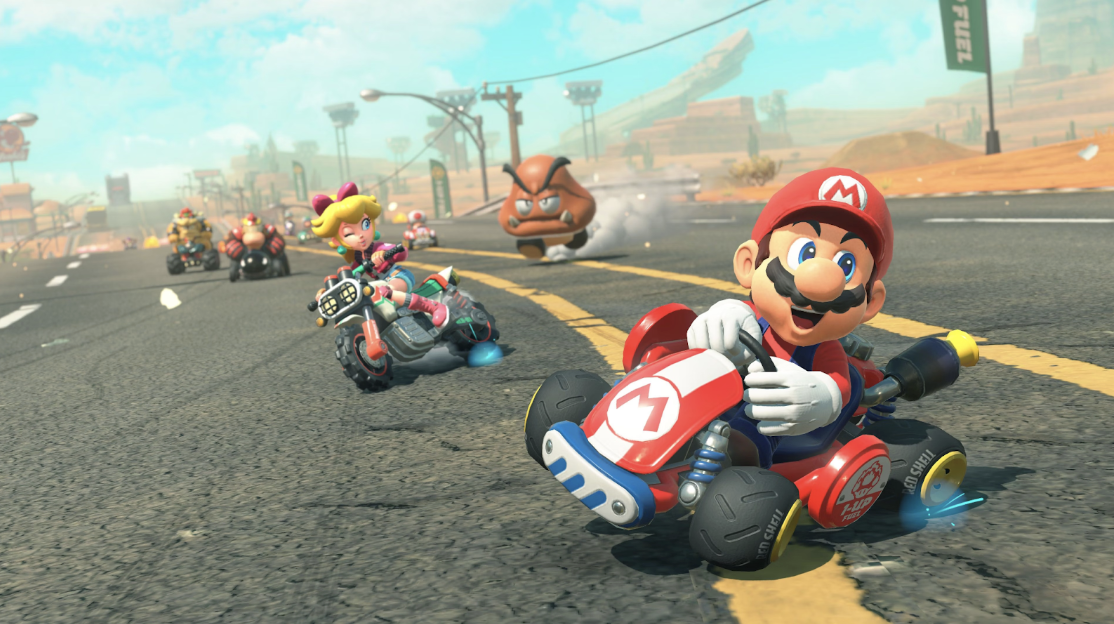
The Mario Kart franchise, created by Nintendo, has become one of the world’s most famous racing game series, and it has gone through much evolution since its inception. The first game, Super Mario Kart, was released in 1992 on the SNES and featured a racing game with 2D graphics. Since then, Mario Kart’s number of courses and game quality have both increased significantly, slowly transitioning into 3D graphics. The game itself is intended to be a children’s party game (though the skill cap is immensely high), so it is fairly easy to pick up and learn.
There are usually four game modes: Grand Prix (four courses in a pre-decided order), VS Race (a Grand Prix with more customizable options), Time Trials (racing against “ghosts” to try to set records on a track), and Battles. Battles are pretty much the “odd one out” of the options, as they are the only ones that don’t utilize actual racing techniques. Instead, they rely heavily on the intricate mechanics within each minigame, each with its own unique set of rules.
There are controls for going forward, backward, turning left and right, and viewing backward (by switching the camera view). There are 12 places (1st through 12th) —8 in the games before Mario Kart Wii, and 24 in Mario Kart World—with a higher place giving a higher point value. For example, first place typically gets 15 points, while 12th place gets 1 point. The objective of the game is to accumulate the largest number of points after several rounds (typically four, though it can be customized in VS Race).
Admittedly, a pure racing game would be a true test of skill, but this was made as a children’s party game. As a result, there’s always a twist; in this case, that would be items. Items take the form of random objects that help the player who uses them. The lightning bolt, for example, shrinks all other players and slows them down. A banana serves as another obstacle on the road, causing a player to spin out if they drive over it. And of course, we can’t forget about the holy grail of annoyance: the dreaded blue shell, which targets the player in first place and causes a massive explosion upon collision.
With a solid foundation like this, it seems impossible for a Mario Kart game to flop, especially with the massive success of the previous installment, Mario Kart 8 Deluxe, and the new features that Mario Kart World brought to the table. However, it’s important to note that having an idea is one thing, and executing it properly is another. In this case, Mario Kart World had a great idea, but lacked decent execution: the game introduced a revolutionary new idea of an open-world map. This was previously unheard of, as the maps for a Mario Kart game had never been interconnected before. The game also added two new modes: Free Roam Mode and Knockout Tour. Free Roam mode allowed players to drive around the entire map and through courses to complete quests and gain rewards. Knockout Tour was essentially an elimination tournament, in which players would compete in a long series of courses, with the slowest few racers disqualified after each round. With these two new modes, Mario Kart World was set up for success. But as more information came out, people started to notice something: most of the new tracks were awfully straight. Out of the four tracks in a Grand Prix, three consisted of mostly driving in a straight line, with only the last portion of the track being the actual course. Essentially, the concept that was supposed to shoot Mario Kart World to stardom was sunk by a small detail. Driving in a straight line took away the fun that the Mario Kart franchise sought to deliver.
As if the lack of difficulty was not enough, there was one more slap to the face with the game’s release: it was exclusive to the Nintendo Switch 2, a console created to effectively replace the Nintendo Switch. It’s a natural rite of passage, and older consoles eventually fade into oblivion, while new consoles get released at rather high prices. The Switch 2 was released at a whopping $450 USD to the public in June, and Mario Kart World was released at approximately $90 USD. Combined, playing Mario Kart World costs a grand total of $540 USD, and this is all before tax.
These two major problems eventually drove most of the Mario Kart community back to Mario Kart 8 Deluxe, which, even after almost a decade, is still flourishing. Mario Kart 8 Deluxe might be popular now, but the servers will eventually be shut down, causing a mass transfer of players to Mario Kart World. Hopefully, by that time, Nintendo will have learned from its mistakes and released updates for Mario Kart World. Until then, this game remains a shadow of the masterpiece it once was intended to be.
Source:
Wikipedia. “Mario Kart – Wikipedia.” Wikipedia, the free encyclopedia, https://en.wikipedia.org/wiki/Mario_Kart. Accessed 23 October 2025.