





































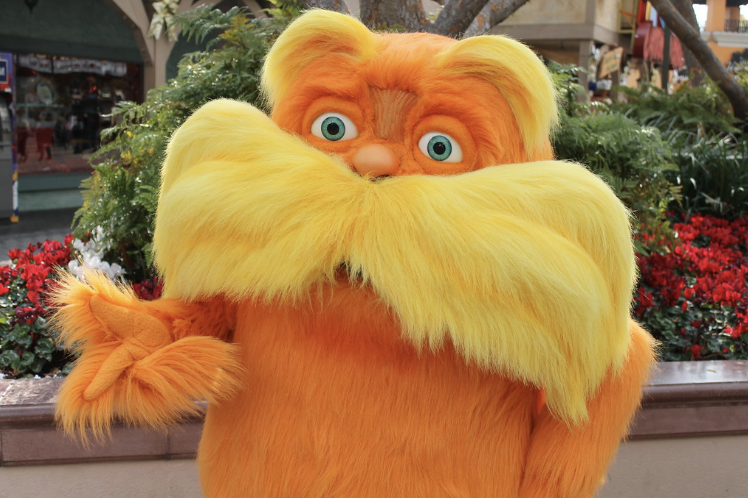
Clips of girls dressed head to toe in neon orange spandex, with bright bushy yellow eyebrows and a pillow stuffed inside their costumes to fake a round belly, have been circulating on TikTok with the caption “Every unfunny, annoying popular girl this Halloween 💔🙏.” Comments flood in: “I’m the Lorax for Halloween, why isn’t anybody laughing?” “They ruined Mr. Bobinsky, too.” “Oh…” Somewhere in the sea of comments, one says, “Maybe I’m too woke, but ‘pretty girl humor’ is the whole ‘I’m not like other girls’ phenomenon.” And they’re not wrong. The idea of “pretty girl humor” seems to be less about humor and more about who’s allowed to be funny.
During the summer of 2025, the label began to appear under clips of girls randomly yelling short, overused phrases such as “Mama dat burn!” or “67”, or subtly teasing others for having interests outside the norm. This label also showed up under videos where girls joined certain trends, such as Junko posing resurfacing or the “bacon avocado” trend (where one yells “bacon avocado” before saying something out-of-pocket in slow motion). The issue wasn’t the jokes themselves, but rather the kinds of girls making them, all of whom were deemed “too pretty” to have good humor or to be part of an interest considered weird. The rise of “pretty girl” humor shows how the Internet treats feminine girls poorly under the guise of a joke.
A well-known example of this is Sydney Sweeney’s What’s It Called interview with W Magazine. She’s shown rotating a magic spinner in her hand, saying, “I’m going to name this Bob. Bob. It looks like a Bob,” while laughing. The video blew up not because people laughed alongside Sweeney, but because they laughed at her. Comment sections flooded with “pretty girl humor at its peak”, calling her “unfunny” and saying she was trying too hard. Many said that because she was born pretty, she didn’t have to develop a personality to be liked. Sydney Sweeney’s joke received backlash not because of her beauty, but also because it was elementary; however, the comments calling it “pretty girl” humor reveal a layer of misogyny that lies hidden: the idea that beauty automatically bans a woman from being weird, ironic, or funny.
“Pretty girl humor” is now code for anything a conventionally attractive girl does that’s unexpected or different, because she must be doing it performatively or as a way to make fun of others who do it. She’s not expected to have her own hobbies, such as cosplaying, because it won’t make her more attractive. This applies solely to girls online; if a conventionally attractive guy were seen cosplaying Luffy from One Piece or Nendo from Saiki K, the comments would be supportive, but the second an attractive girl lays her eyes on a Mr. Bobinsky cosplay, she’s instantly bombarded with “pretty girl humor” comments. Authenticity depends on who’s being watched, and in this case, femininity loses.
Slideshow trends have exemplified this effect. Girls post photos of themselves now, with a bun, Lululemon, perfect makeup, perhaps an Owala, and the caption “When they say I have pretty girl humor.” Swipe, and the next slide shows them in 2020 with a neon wig, Dream SMP hoodie, anime cosplay, or an awkward dance, and the caption “…but trust me, I know ball.” The message they wish to send is “I was one of the weird kids too once, and I have a personality other than being pretty.” It’s meant to prove that their beauty didn’t erase their personality, and they earned their humor. Comments saying “Didn’t know you were one of us” reaffirm their underlying idea: pretty girls can’t do anything considered niche. The need to prove oneself, to say they were weird before they had a glow-up, is proof of the misogyny women face online. You can’t exist as a girl who’s funny and looks like Adriana Lima; you have to show receipts that you used to be socially awkward and developed your personality on your own. Otherwise, you’re stealing humor that you didn’t earn.
Take the infamous Lorax costume. The most famous Halloween 2024 costume, which used to be quirky, is now considered basic and “pretty girl humor”. TikToks mocking the costume were everywhere in 2025, calling the Lorax girls annoying and saying that pretty girls are fake for trying to be different, because their version of different is performative. People want to believe they’re calling out trend-followers or shallowness, but the real message is that these girls’ personalities are seen as inauthentic simply because they’re conventionally attractive. The curated pretty girl on your page can’t genuinely be listening to The Living Tombstone; she must be doing that to make fun of people or to get attention from guys who listen to them. It has to be calculated and for attention; she can’t just be funny. She’s too pretty for that.
Influencers like AvaScreams have been lumped into this double standard. In 2020, she was known for her quick Danganronpa posing, cosplays, and K-pop stan behavior. AnimeTok loved her, and she was part of TikTok’s “weird” side. Fast-forward to 2025, where she still occasionally cosplays and dances to BTS songs, but the comments now say, “Didn’t know you were one of us.” The main difference is that now, since AvaScreams has passed puberty and grown into her features, she’s gotten more conventionally attractive. And her good looks mean that her previous personality and interests must be canceled out. People assume that because she’s become beautiful, she’s abandoned her hobbies for attention. It’s a recurring cycle in which the internet overlooks people’s pasts to fit their current selves into designated boxes.
The whole thing screams, “I’m not like other girls.” In 2016, girls who “weren’t like other girls” didn’t wear makeup, ate hot wings, and watched football with the boys. Their reason? They couldn’t be “girly” because they found girls who did to be corny and attention-seeking. That mindset continues today, where the Internet punishes women for being slightly feminine. Pretty girls are always “doing it for the male gaze”, since they can’t authentically be that way. They can’t have a personality and be attractive; they can only have one or the other. If the Internet can’t consider the idea that a beautiful girl can have eccentric interests, the stereotype that all pretty girls are bimbos will forever exist.